 RevisionAdda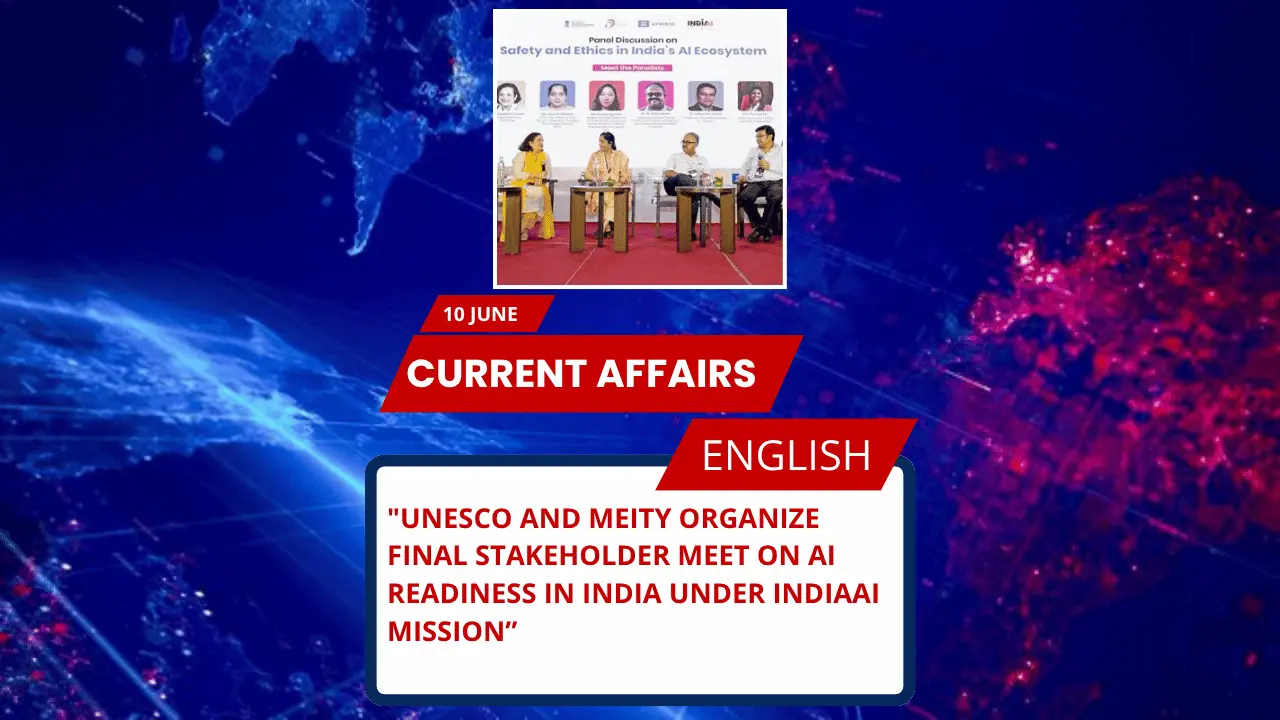
Key Points for SSC, UPSC & Other Government Exams
- Event: 5th and final Stakeholder Consultation on AI Readiness Assessment Methodology (RAM)
- Date & Venue: 3rd June 2025, Shangri-La Eros Hotel, New Delhi
- Organized by: UNESCO Regional Office for South Asia, IndiaAI Mission (MeitY), Ikigai Law
- Key Objective: To build an India-specific policy report for ethical and responsible AI adoption
- Important Initiative: IndiaAI Mission with a focus on “Safe and Trusted AI”
- Panel Members: Officials from NITI Aayog, MeitY, UNESCO, IIT Madras, IIT Jodhpur
- Key Platforms Mentioned: AI Kosh (AI datasets), Responsible AI projects
- Breakout Sessions Focus Areas: Governance, Infrastructure, Youth, Workforce Readiness, Sectoral AI
Complete Blog
India is stepping forward with a strong commitment to ethical, safe, and responsible artificial intelligence. The 5th and final stakeholder consultation on AI Readiness Assessment Methodology (RAM) was held on 3rd June 2025 in New Delhi by UNESCO Regional Office for South Asia, IndiaAI Mission (MeitY), and Ikigai Law.
This event is a part of the AI RAM initiative, a framework to assess and improve a nation’s AI preparedness. Previous sessions were held in Delhi, Bangalore, Hyderabad, and Guwahati. The final meet brought together over 200 experts from across government, academia, private sector, and civil society to deliberate on India’s roadmap for responsible AI.
What is AI RAM (Readiness Assessment Methodology)?
AI RAM is a diagnostic tool developed by UNESCO to assess a country’s AI ecosystem across five major areas:
- Legal & Regulatory
- Economic
- Social & Cultural
- Scientific & Educational
- Technological & Infrastructural
Unlike many other global tools, RAM is adapted specifically to each country’s context, offering a more personalized and effective assessment. For India, this process is being shaped by experts under the IndiaAI Mission, which aims to democratize AI access and ensure trustworthy applications.
IndiaAI Mission Highlights
- Central pillar: Safe and Trusted AI
- Tools: AI Kosh platform (for datasets), development of foundation models, and promotion of Responsible AI
- Leadership: Mr. Abhishek Singh (Additional Secretary, MeitY; CEO, IndiaAI Mission)
In his address, Mr. Singh emphasized India’s balanced, innovation-friendly AI strategy, aiming to both develop AI in India and for India.
Voices from the Panel
- Ms. Debjani Ghosh (NITI Aayog) stressed the importance of the industry’s role in safe AI development.
- Ms. Kavita Bhatia (COO, IndiaAI Mission) praised the collaborative approach bringing together public and private stakeholders.
- Dr. B. Ravindran (IIT Madras) and Dr. Mayank Vatsa (IIT Jodhpur) contributed insights on policy and research directions.
- Ms. Eunsong Kim (UNESCO) reiterated the role of ethics-by-design in creating a trustworthy AI framework.
Focus of Breakout Sessions
- Governance and Regulation
- Infrastructure & Technology
- Workforce & Skills Development
- Sector-wise AI Implementation
- Youth Engagement in AI Policy
These discussions will directly feed into India’s AI Policy Roadmap, helping make AI more inclusive and effective.
About the Organizations Mentioned
UNESCO (United Nations Educational, Scientific and Cultural Organization)
- Founded: 1945
- Headquarters: Paris, France
- Mission: Promote peace and security through international cooperation in education, sciences, and culture.
- AI Role: Leads development of ethical guidelines and readiness tools like RAM for global AI governance.
MeitY (Ministry of Electronics and Information Technology, India)
- Minister: Ashwini Vaishnaw (as of 2025)
- Key Initiatives: IndiaAI Mission, Digital India, Cybersecurity policy, National Data Governance Framework
IndiaAI Mission
- Launched by: MeitY, Government of India
- Pillars: Compute, Datasets, Innovation, Skills, Safe & Trusted AI
- Goal: To position India as a global leader in AI development and responsible use.
Potential MCQs for Exams
1. Which of the following organizations collaborated to organize the 5th Stakeholder Consultation on AI Readiness in India?
A. UNESCO, IndiaAI Mission, Ikigai Law
B. WHO, MeitY, DRDO
C. NITI Aayog, IIT Delhi, CSIR
D. UNDP, RBI, NPCI
Answer: A
2. The AI Readiness Assessment Methodology (RAM) is primarily designed to:
A. Develop AI robots for commercial use
B. Fund AI startups in India
C. Evaluate and strengthen AI ecosystem and governance
D. Replace manual workers with AI
Answer: C
3. The ‘Safe and Trusted AI’ pillar is a part of which national mission?
A. Atmanirbhar Bharat
B. Make in India
C. IndiaAI Mission
D. Digital India 2.0
Answer: C
4. AI Kosh platform is related to:
A. Cybercrime tracking
B. Open-source AI tools
C. Storage and sharing of AI datasets
D. AI testing and validation
Answer: C
5. Who delivered the keynote speech during the 5th AI RAM Consultation?
A. Ashwini Vaishnaw
B. Debjani Ghosh
C. Abhishek Singh
D. Ravi Shankar Prasad
Answer: C